

Nurturing Economics Talent and Public University Capacity in Nepal

Dr. Alok K. Bohara
As Nepal positions itself to turn a new page—with renewed energy and a strong public mandate—the early signals from the new government suggest movement on multiple fronts: tackling corruption, streamlining bureaucracy, and attempting to restore administrative purpose. These are important beginnings. Their long-term impact, however, will depend not only on action, but on process—on maintaining public trust through transparency, regular communication, and a willingness to bring citizens along. Clear, direct engagement—beyond the noise of routine press interactions—can help sustain that trust.
This short reflection, however, is less about immediate governance and more about a parallel opportunity: the role of higher education—particularly the public university system—in supporting Nepal’s next phase of development.
I was recently honored to engage with faculty and students at the Central Department of Economics at Tribhuvan University on the theme of “Governance Systems vs Narrative Systems.” The discussion explored a familiar puzzle: why stable institutions remain elusive despite repeated political transitions, and how both formal governance systems and public narratives shape outcomes in complex ways.
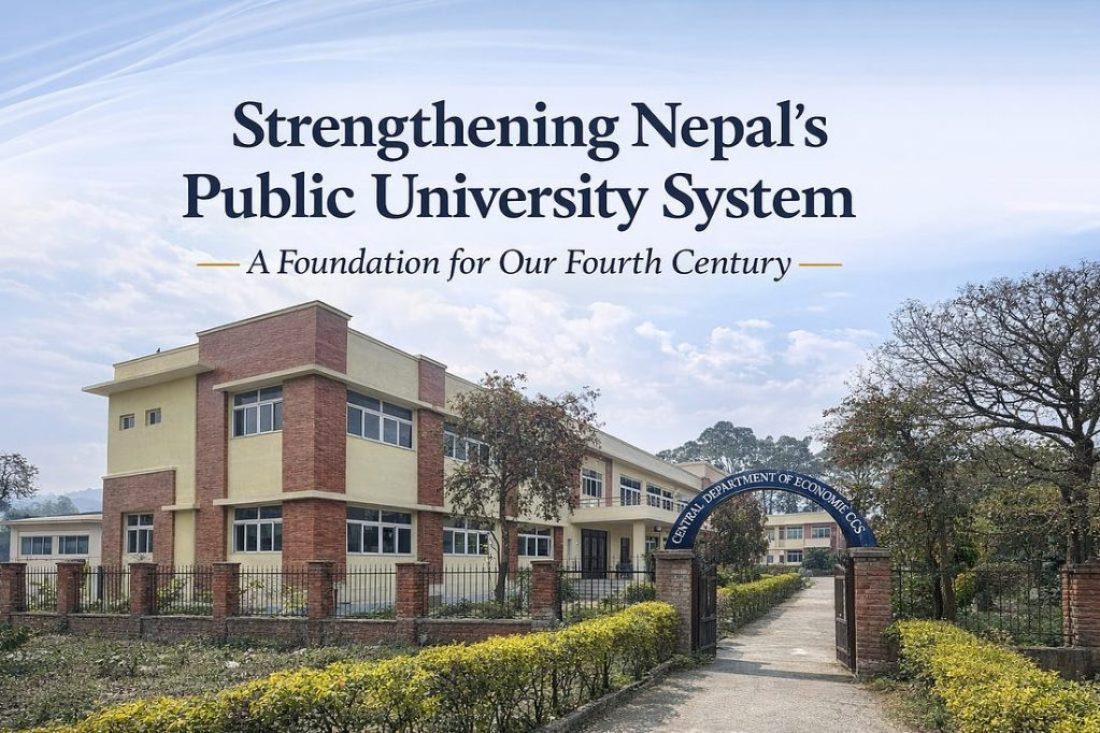
Walking into the new building and seeing a room full of engaged faculty and enthusiastic students brought back an earlier memory. Years ago, a small group of us had explored the idea of building a “school of economics” that could provide the analytical firepower—multidisciplinary, collaborative, and evidence-driven—needed for Nepal’s policy design and institutional thinking. That aspiration, along with broader conversations around a three-tier higher education reform agenda, has stayed with me over the years.
What felt striking this time was not just the memory, but the possibility. The energy, the scale of student engagement, and the depth of interest suggest that Nepal’s public universities hold significant untapped potential. The issue is less about talent and more about how that talent is organized, supported, and connected to national priorities.
The capacity clearly exists. With nearly 400 students currently enrolled in the graduate program at TU alone—and many more across the system—the question is not one of talent, but of connection: how to better link this intellectual reservoir to national policy design, especially as Nepal seeks to move beyond a remittance-driven economy toward a more productive and coordinated one.
I have had the benefit of seeing this potential firsthand through my work at the University of New Mexico, where I have trained and mentored PhD students who began their academic journeys at Tribhuvan University’s economics department. Their analytical ability, discipline, and adaptability have consistently reinforced my sense that Nepal’s public university system already possesses the human foundation needed for a much stronger research and policy ecosystem.
Independent institutions such as Kathmandu University have demonstrated the value of focused, high-quality programs, though often at a cost structure that limits broad access. This reinforces a simple but important point: a country like Nepal cannot rely solely on elite or high-cost models. A strong, well-functioning public university system —serving a vast number of population— is essential—not just for access, but for building the scale of human capital required for national development.
Countries that have made sustained progress have often benefited from institutional anchors—universities that serve not only as teaching centers but as engines of policy-relevant thinking. The question for Nepal is how to build and strengthen such capacity within its public system.
This may require a more deliberate effort to nurture a think-tank ecosystem within public universities—one that is empirically grounded, multidisciplinary, policy-oriented, and connected to the evolving needs of the country. Earlier ideas around a dedicated social science research and funding mechanism—discussed with former vice chancellors such as Kedar Bhakta Mathema, Suresh Raj Sharma, and Madhav Prasad Sharma—may be worth revisiting in this context.
At a moment like this, there may also be value—borrowing from Abraham Lincoln’s notion of a “team of rivals”—in drawing on a broad spectrum of experience. The new finance minister, Dr. Swarnim Wagle, brings both academic and policy insight, and could benefit from engaging seasoned voices, including former finance ministers Dr. Prakash C. Lohani, Dr. Devendra Raj Panday, and Mr. Surendra Panday.
In that spirit, one is reminded of evolutionary biologist Sara Walker’s observation that institutional memory, much like memory in biological systems, plays a critical role in guiding evolution—helping systems learn, adapt, and avoid repeating past mistakes. For Nepal, building such memory within its academic and policy institutions may be as important as any immediate reform.
Looking ahead, this effort could be further strengthened by aligning higher education with Nepal’s broader development framework—particularly the ACE model (see previous essays) of agriculture, culture and tourism, and energy. An eco-zone university system, organized around the country’s major ecological corridors, can help embed these priorities within the structure of learning itself. By linking universities, technical institutes, and research centers across mountain, hill, and terai contexts within each zone, and integrating them into a three-tier higher education framework, Nepal can better connect knowledge, skills, and innovation to the specific resources, needs, and opportunities of each region. In doing so, education becomes not just a pathway for individual advancement, but a coordinated system for national development.
As the country looks ahead to its next phase—what one might call its fourth century—the alignment of governance, knowledge, and human capital will matter deeply. Strengthening the public university system as a space for rigorous thinking, research, and policy engagement could be one of the most consequential investments in that transition.
Dr. Alok K. Bohara, Emeritus Professor of Economics at the University of New Mexico, writes as an independent observer of Nepal’s democratic evolution through the lens of complexity and emergence science. His systems-policy essays on Nepal’s socio-economic and political landscape appear on Nepal Unplugged.