
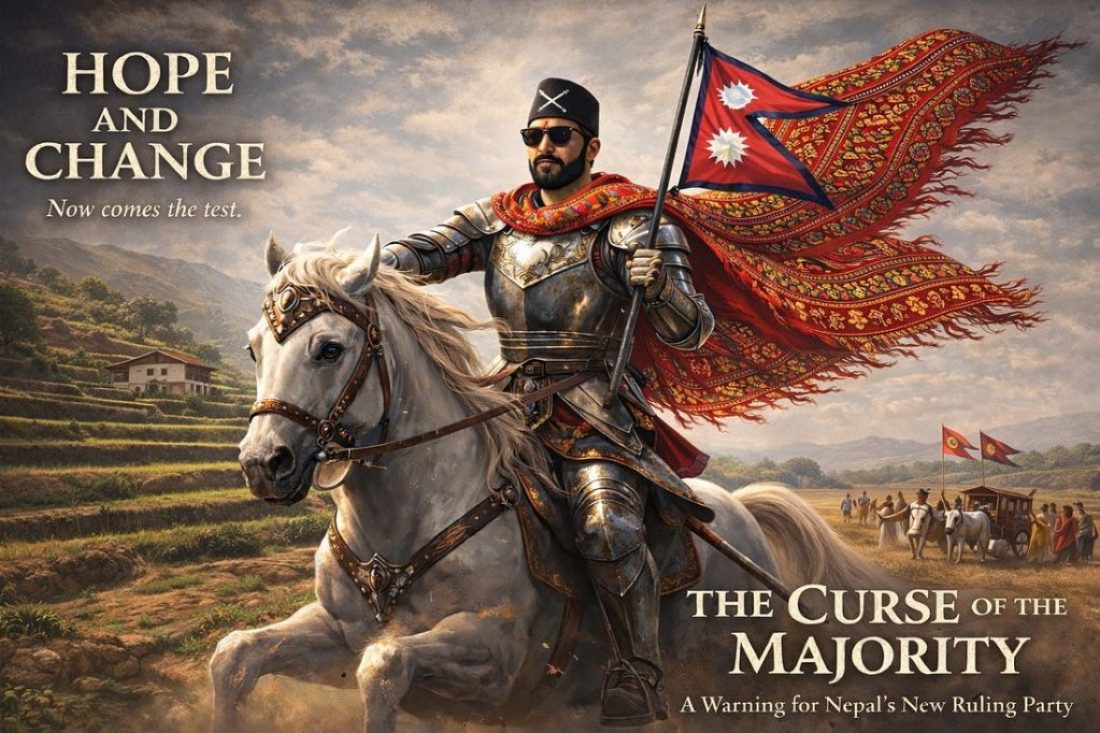
The Curse of the Majority: A Moment of Opportunity for RSP

Dr. Alok K. Bohara
Preamble: Nepal has reached a rare political moment. The sweeping mandate given to the Rastriya Swatantra Party reflects a deep public desire to clean up politics and restore credibility to governance.
History, however, offers a warning. Large mandates in Nepal—from the democratic restoration of 1990 to the republican transition and beyond—have often fallen victim to the curse of the majority, when overwhelming power weakens the discipline needed to protect institutions.
The real test now is reform. If this mandate is to matter, it must translate into institutional change. Among many reforms that deserve attention, a few require immediate action: a professional executive where ministers are not simultaneously members of parliament, a broader and more democratic process for electing the president, a more accountable and directly elected upper house, and electoral rules that strengthen competition rather than patronage. Whether Nepal repeats its familiar cycle of mandate and disappointment—or finally breaks it—will depend on what happens next.
Nepal’s latest election has produced a remarkable political moment. The sweeping victory of the Rastriya Swatantra Party (RSP), following the civic awakening led largely by Gen-Z voters, has dismantled much of the old political order. Such electoral shocks are rare in democratic systems. They usually reflect deep public frustration—but also deep hope.
Yet Nepal’s political history suggests that overwhelming mandates can carry hidden dangers. Time and again, leaders who came to power with historic legitimacy eventually encountered what might be called the curse of the majority.
Before reflecting on that risk, it is worth acknowledging the historical contributions of the leaders who preceded this moment.
In 1990, Girija Prasad Koirala and the Nepali Congress helped restore multiparty democracy after decades of authoritarian rule. That moment represented a victory for liberty and political freedom. The door to democratic competition was reopened.
Years later, Prachanda and the Maoist movement brought another powerful political current into the national mainstream. The republican transition, despite the violent path that preceded it, ultimately expanded the agenda of social justice and inclusion in Nepal’s political imagination.
More recently, K.P. Oli presided over the constitutional settlement (with Sushil Koirala) that formalized the federal republican framework. That period, despite its intense political contestation and blockade, completed an important stage of Nepal’s constitutional evolution.
Each of these leaders played a role in shaping the modern Nepali state. Yet each of them also encountered the same paradox: once in power with large mandates, their governments eventually succumbed to the curse of the majority—internal conflict, institutional overreach, or political fragmentation.
Nepal now stands at another such moment.
The Balen Moment and a New Political Energy
The rise of new political energy did not emerge in isolation. One important symbolic turning point came from outside traditional party structures.
When Balen Shah won the Kathmandu mayoral election, it sent a signal that citizens were willing to bypass established political machinery. His Janakpur speech, in particular, resonated across the Terai.
For many Madhesi citizens, it felt as if a long-missing message had finally been spoken: that they were not outsiders to the Nepali state but equal participants in it.
For a brief moment, a large section of the Terai—especially among younger voters—felt that a “knight in shining armor” had appeared who spoke their language and gave hope beyond the traditional divisions of Kathmandu politics.
That emotional shift matters. It helped create the civic energy that ultimately fueled the broader electoral correction we are witnessing today.
Now that energy has translated into a parliamentary mandate for RSP.
But this is precisely where Nepal’s political history offers its warning.
The Curse of the Majority
Large victories can create a dangerous illusion: that electoral legitimacy alone is enough to transform a system. In reality, large mandates often produce three temptations.
First, the temptation to dominate institutions rather than strengthen them.
Second, the temptation to suppress internal debate in the name of unity.
Third, the temptation to move too quickly without building durable institutional rules.
Nepal has experienced all three.
The lesson for the new political leadership is therefore straightforward: a large majority should produce humility and restraint, not triumphalism.
The real test of a political movement begins after it wins power.
Now Comes the Real Test: Reform
RSP has spent years arguing that Nepal’s governance model requires structural reform. The present mandate now gives them a rare opportunity to translate those ideas into practice.
This election was not formally conducted under a directly elected prime ministerial system. Yet the scale of the mandate resembles what such a system might produce. In effect, voters have delivered a signal similar to a direct mandate.
The question now is whether the party will act on the reforms it has long advocated.
One such reform concerns the relationship between ministers and parliament.
RSP has repeatedly argued that ministers should not simultaneously serve as Members of Parliament. This principle would move Nepal closer to a professional executive structure, where ministers are selected based on expertise rather than parliamentary bargaining.
Another reform concerns the presidency.
Currently, Nepal’s president is chosen by a relatively small electoral college composed of national and provincial political elites (800+). The process is often shaped by intense political bargaining behind closed doors.
An alternative would be to elect the president through a much broader electoral base—for example, by involving tens of thousands of elected representatives from across the country, including ward-level officials (35000+). Such a system would remain indirect, but it would dramatically widen democratic participation and reduce elite horse-trading.
A third area concerns the National Assembly.
At present, the upper house largely reflects a share-based political arrangement among parties. A stronger institutional design might involve direct election of National Assembly members, creating a chamber with clearer democratic legitimacy and independence.
These are not radical proposals. They are governance reforms that RSP itself has previously discussed. Implementing even some of them would signal a serious break from the political habits of the past.
In other words, it would demonstrate that this new political moment is not merely about replacing one set of leaders with another.
Putting the Mandate to Work
Nepal’s voters have sent a powerful message. They want a politics that is cleaner, more accountable, and more forward-looking.
But electoral waves can fade quickly if they do not translate into institutional reform.
The opportunity before RSP is therefore historic. If it uses its mandate to strengthen institutions, expand democratic participation, and implement the governance reforms it has long advocated, Nepal may finally move beyond the cycles of political breakdown that have marked the past three decades.
If not, the country may once again rediscover the old lesson of Nepali politics: that the greatest danger for a new government often lies not in its opposition, but in the size of its own victory.
Dr. Alok K. Bohara, Emeritus Professor of Economics at the University of New Mexico, writes as an independent observer of Nepal’s democratic evolution through the lens of complexity and emergence science. His systems-policy essays on Nepal’s socio-economic and political landscape appear on Nepal Unplugged.