
Nepal Banking Leaders Address AI Adoption Challenges at Kathmandu Symposium

12th Janaury 2025, Kathmandu
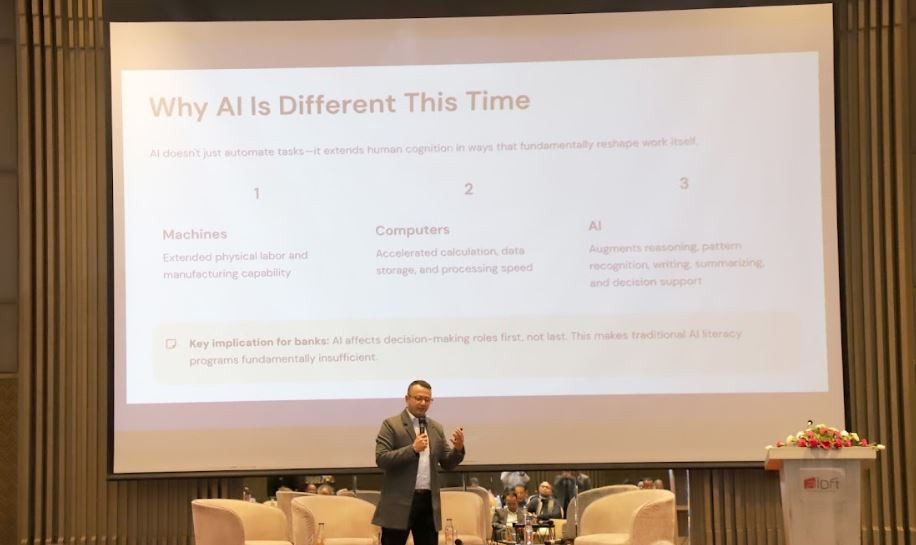
Senior banking executives and international AI experts gathered in Nepal’s capital Monday to confront a pressing question: How can financial institutions move beyond the hype around artificial intelligence to build real capability for adoption?
The symposium, titled “AI and the Future of Leadership” and co-organized by the Drucker Leadership Academy, NAAMII, and Tangible Careers, drew more than 50 participants including CEOs of Nepal’s major commercial banks, government officials, and academics from multiple countries.
Bam Bahadur Mishra, Deputy Governor of Nepal Rastra Bank, the country’s central bank, opened the event with a call for financial leaders to balance technological innovation with regulatory stability. “Leadership in the AI era demands both technological fluency and unwavering commitment to financial integrity,” he said.
The gathering comes as Nepal’s banking sector, which has rapidly digitized over the past decade, faces pressure to determine which AI applications offer genuine value versus those driven by market hype.
In a panel discussion on institutional readiness, Satyendra Timilsina, Executive Director at Nepal Rastra Bank’s Payment Systems Department, joined Suman Pokharel, Deputy CEO of Global IME Bank, and Professor Francois Rameau to examine the practical infrastructure and governance frameworks needed for systematic AI implementation.
“Institutional readiness requires not just technological investment, but organizational culture shifts and measured approaches that balance innovation with risk management,” panelists concluded.
A second panel, moderated by NAAMII’s Sandhya Sitoula, addressed ethical concerns around algorithmic bias and data privacy. Govinda Gurung, CEO of Agriculture Development Bank Ltd., and Ashutosh Modi, an associate professor at IIT, emphasized Nepal’s opportunity to build ethical guardrails into its AI strategy from the outset.
Alok Khatri, co-founder of Tangible Careers, presented a framework for workforce reskilling that was well-received by industry and academic attendees. His presentation focused on building capability infrastructure to match the pace of AI-driven workplace disruption.
Other speakers included Prabin Raj Pokharel of the Drucker Leadership Academy, who traced technology adoption patterns in Nepal’s banking sector; NAAMII’s Bisesh Khanal and Professor Virginia Dignum on AI technical standards; and government and industry representatives on digital infrastructure requirements.
Organizers said follow-up working groups will meet in early 2026 to develop policy recommendations.