
Nepal launches national campaign to bring informal workers into social security
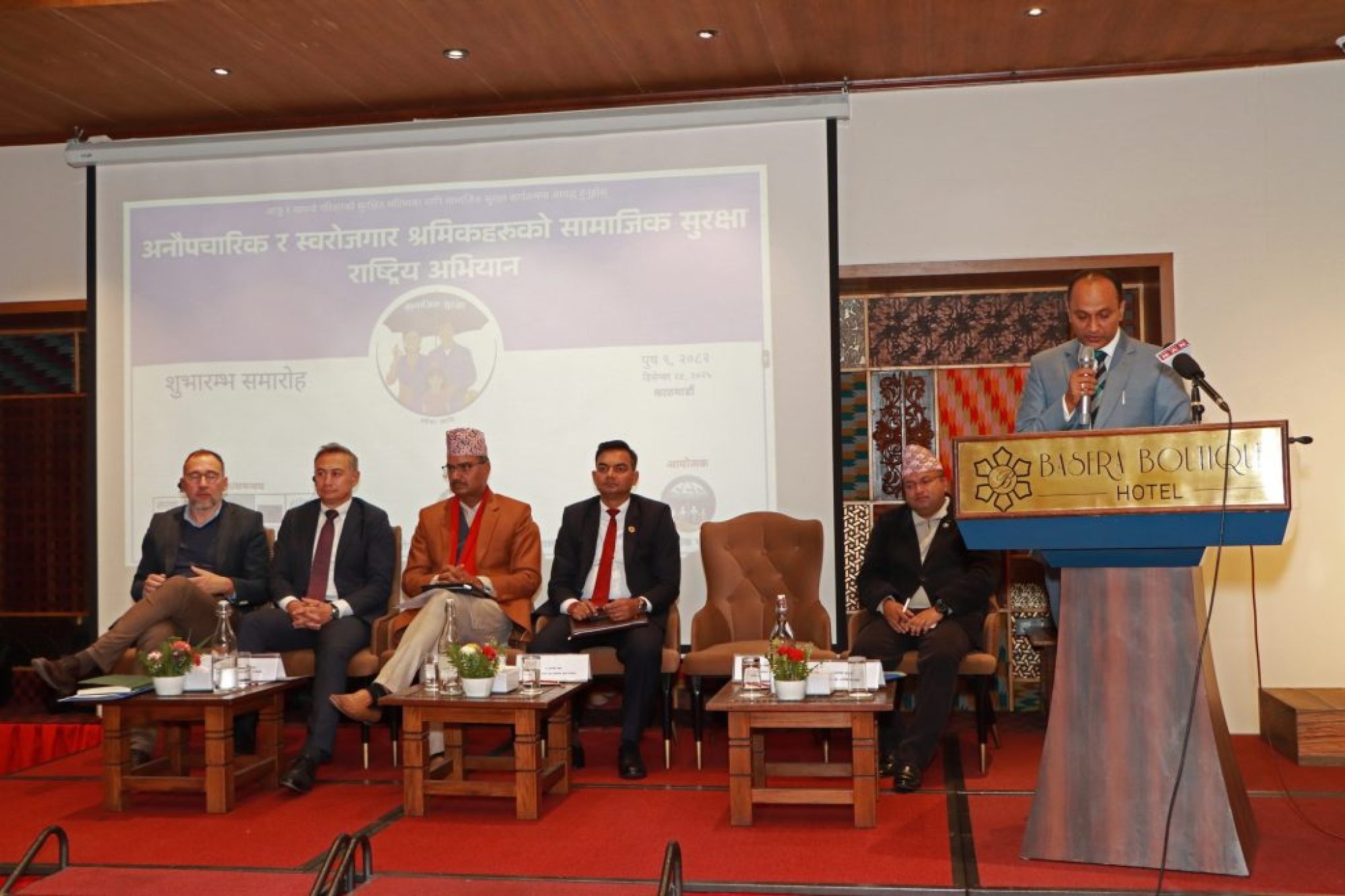

25th December 2025, Kathmandu
Nepal has launched a National Campaign on Social Security for Informal Workers and the Self-Employed, a major step toward ensuring that millions of workers currently outside formal safety nets can access protection throughout their life cycle.
The scale of the challenge is clear: over 86 percent of workers in Nepal are in informal employment, and women are disproportionately affected—over 90 percent of employed women work informally.
Yet, while nearly 2.7 million workers are registered with the Social Security Fund (SSF), the number of informal workers and the self-employed enrolled is only about 1500, highlighting a critical inclusion gap.
The campaign—launched by the Social Security Fund (SSF) in collaboration with the ILO Nepal- brings together government institutions, employers’ and workers’ organizations, local governments, civil society, and the media to expand coverage to those who need it most.
Speaking at the launch, Numan Özcan, ILO Country Director for Nepal, said: “This campaign is about ensuring that no worker is left behind. Social security is fundamental to equity, economic resilience, and inclusive development.”
Why does this matter for women?
For many women in informal work, the absence of social security is not an abstract policy gap—it can determine whether maternity means protection or loss of income, whether illness leads to treatment or debt, and whether old age brings dignity or dependence.
This is why the campaign is supported through EU funding under the women’s empowerment programme (EWPN)—to help strengthen women’s economic agency and reduce vulnerability across generations.
Mr. Jose-Luis Vinuesa-Santamaria, Head of Cooperation, European Union (EU) Delegation to Nepal, stated, “Social security is a right and a forward-looking investment in people, deeply rooted in Europe’s own social model. The EU affirms that workers have the right to social protection regardless of the type and duration of their work.”
Nepal has established a robust legal framework through its Constitution and the Contribution-Based Social Security Act (2017), and has rapidly expanded coverage in recent years.
Effective social protection coverage has increased from 17 percent (2021) to 21 percent (2023), but major challenges remain in adequacy and inclusion.
The Government’s 16th Periodic Development Plan commits to expanding coverage to 60 percent of the population and significantly reducing informality by 2028.
Chief guest at the event, Honourable Mr Rajendra Singh Bhandari, Minister, Ministry of Labour, Employment and Social Security (MoLESS), said, “The umbrella in the logo of this campaign is symbolic. No matter how heavy the rain, what matters is how strong the umbrella is. Social security should act as that protective armour. Poorly integrated systems lead to social unrest, conflict, and forced migration, realities we already face.”
He added, “Employment, labour, and social security are interconnected, yet our resources are treated as liabilities rather than assets. Beyond time-bound plans, it is our responsibility to strengthen systems. Change cannot rely on individuals alone; it is the State’s duty. This campaign is both our responsibility and an opportunity for real transformation.”